How Much Income Do You Realistically Need to Afford a Home in Wilmington, DE in 2026?
This is the question people are almost embarrassed to ask — but they shouldn't be. Knowing whether you can actually afford to buy in Wilmington before you fall in love with a listing is one of the smartest things you can do. And the answer is more accessible than most people think.
I'm Bob McCranie, Broker Associate at HomeSmart and a 23-year veteran of the Delaware real estate market. Before we talk neighborhoods, styles, or square footage, I always sit down with buyers and have the honest income conversation. Here's what that looks like for Wilmington in 2026.
The Standard Formula — and Why It's Just the Starting Point
What do lenders actually use to qualify buyers?
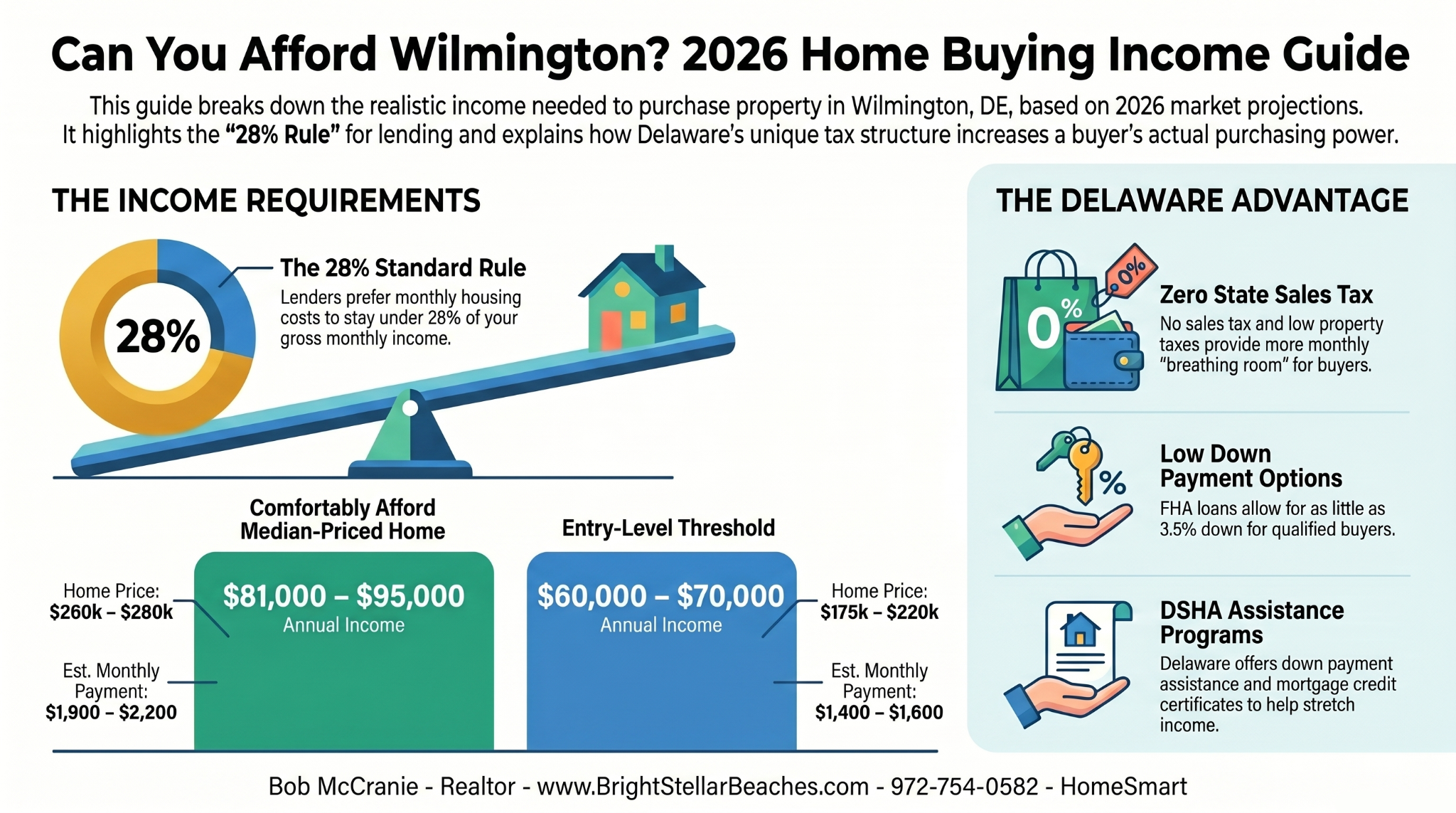
Most mortgage lenders use a debt-to-income ratio (DTI) as their primary qualifying metric. The conventional guideline is that your total monthly housing costs — principal, interest, taxes, insurance, and any HOA — should not exceed 28% of your gross monthly income. Your total monthly debt obligations (housing plus car payments, student loans, credit cards, etc.) should ideally stay under 43%.
Let's run those numbers for Wilmington's current market.
With a median home price in Wilmington hovering around $260,000–$280,000 for a traditional single-family home, and assuming a 10% down payment at today's rates near 6.75–7%, your principal and interest payment lands roughly in the $1,650–$1,800/month range. Add property taxes (Delaware's are among the lowest in the Mid-Atlantic — see our property tax deep-dive) and homeowner's insurance, and you're looking at a total housing payment somewhere in the $1,900–$2,200/month range for a typical Wilmington purchase.
Using the 28% rule, that translates to a gross monthly income of approximately $6,800–$7,900/month — or $81,000–$95,000 annually — to comfortably qualify for a median-priced Wilmington home with standard DTI guidelines.
What About Lower Price Points?
Can buyers with more modest incomes still get into Wilmington?
Absolutely — and this is where Wilmington genuinely shines compared to other East Coast cities. Wilmington homes under $500k includes a wide range, and at the lower end — say, a $175,000–$220,000 purchase — the income threshold drops meaningfully.
At $200,000 with a 5% down payment (FHA allows as low as 3.5%), you're looking at a total monthly housing payment in the $1,400–$1,600 range. That brings the qualifying income down to roughly $60,000–$70,000 annually — accessible to a much broader range of buyers.
Wilmington condominiums and townhomes often offer an accessible entry point with lower maintenance responsibility — worth considering if a detached home at your target price point is proving elusive.
Delaware's Income Advantage: No State Sales Tax
How does Delaware's tax structure affect buying power?
Here's what most out-of-state buyers don't factor in: Delaware has no state sales tax and relatively low property taxes. That means more of your income stays in your pocket month to month compared to what you'd experience in New Jersey, Pennsylvania, or Maryland — and that directly affects your real purchasing power.
A buyer earning $80,000 in Delaware keeps meaningfully more after taxes than the same earner in neighboring states. That financial breathing room translates directly into homebuying capacity.
First-Time Buyer Programs Worth Knowing
Are there programs that can help stretch my qualifying income?
Delaware has some excellent resources for first-time buyers that can make a real difference:
Delaware State Housing Authority (DSHA) offers down payment assistance programs, mortgage credit certificates, and favorable rate programs for qualifying buyers. These can significantly reduce the upfront cash required and, in some cases, lower your effective interest rate.
FHA loans remain accessible with credit scores as low as 580 and down payments as low as 3.5% — reducing the savings barrier for buyers who have solid income but haven't built a large down payment yet.
USDA loans apply to some Delaware communities that qualify as rural or semi-rural — worth exploring for buyers open to areas outside Wilmington's urban core.
The key is working with an agent who knows which programs align with your profile. After 23 years in this market and over 1,561 homes sold, I've connected many buyers with programs they didn't know existed — and those programs made the difference between renting another year and closing on a home.
What Bob Tells Buyers About the Income Question
With 45 five-star Google reviews from Delaware buyers across every income level, here's what I've seen consistently: buyers who get pre-approved early — before they're emotionally attached to a specific home — make dramatically better decisions. They know their real number, they shop in the right range, and they avoid the heartbreak of falling for something that doesn't fit.
As I tell every buyer at our first meeting: "Your pre-approval isn't a ceiling — it's a tool. Let's figure out what you're comfortable with, not just what a lender will approve."
View Wilmington homes across all price ranges | Check the Wilmington market report | New Castle County homes
Contact Bob McCranie at HomeSmart | 972-754-0582 | BobMcCranie@gmail.com for a FREE 2026 Market Strategy Session.